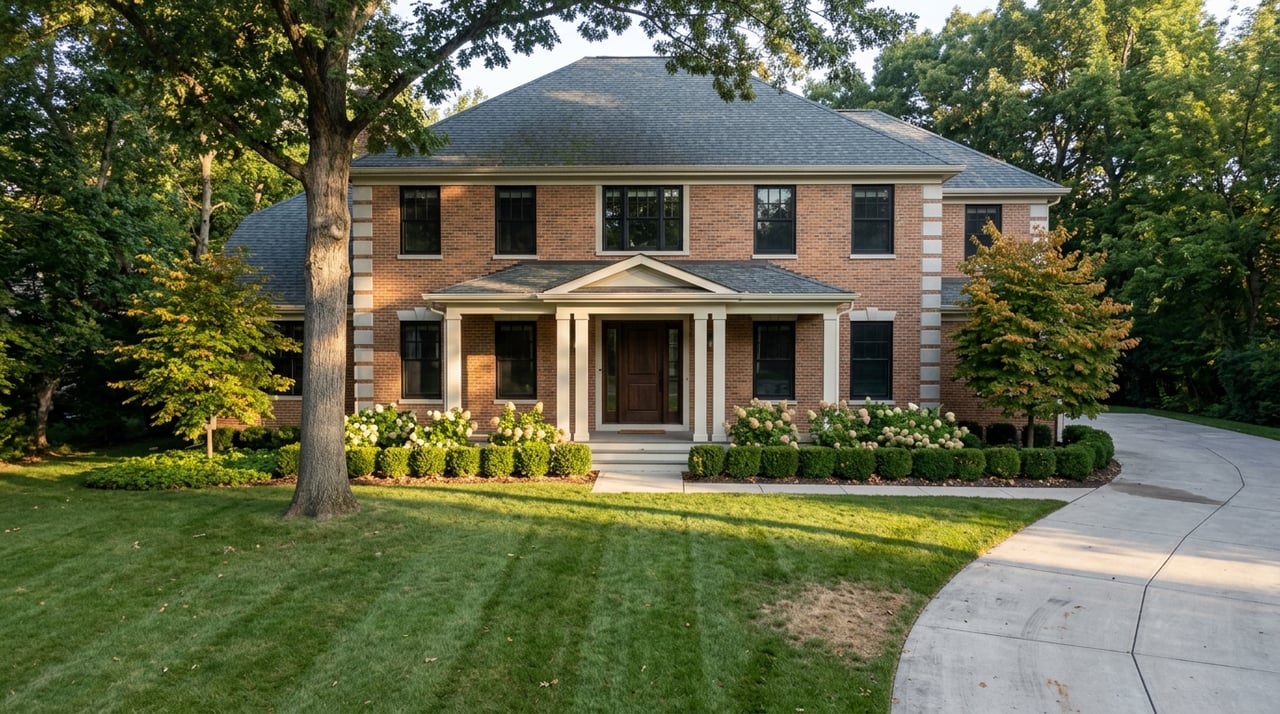
Picture two Beachwood homeowners two doors apart, each with a nearly identical colonial. One pulls up an online estimate that has climbed steadily for a year. The other lists at what feels like a fair, current price and watches it sit for two months before an offer arrives well under what that same estimate would have predicted. Same street. Same era of house. Two completely different stories about what a Beachwood home is worth right now.
That gap is not a fluke, and it is not one seller's bad luck. It is what happens when four different tracking systems are all measuring the same small city at the same time and coming up with different answers, because they are not actually measuring the same thing.
Four Numbers, One City
Anyone who spends ten minutes searching "Beachwood home prices" will run into a wall of numbers that do not line up. Redfin's transaction data, current as of September 2025, put the median sale price at $407,000, down about 9 percent from the year before, with homes taking a median of 67 days to sell compared with 40 days the prior year. Zillow's home value index, updated through June 2026, told a different story entirely: a typical Beachwood home worth $419,565, up 5.5 percent over the past year. Meanwhile, list-price trackers showed sellers asking for more than either of those figures suggest buyers were paying. Movoto had the median list price at $547,000 in June 2026. Homes.com put it at $480,000 in May 2026, with condos alone spanning from $129,900 to $465,000. By August 2026, active for-sale-by-owner listings showed the average single-family home asking $623,818 against an average condo asking $541,396.
Here is that same picture laid out side by side.
| Source | What It Measures | Figure | As Of |
|---|---|---|---|
| Redfin | Median sale price (closed transactions) | $407,000, down 9% year over year | September 2025 |
| Redfin | Days on market | 67 days, up from 40 | September 2025 |
| Zillow | Home value index (modeled estimate) | $419,565, up 5.5% year over year | June 2026 |
| Movoto | Median list price | $547,000 | June 2026 |
| Homes.com | Median list price / condo range | $480,000 / $129,900 to $465,000 | May 2026 |
| FSBO listings | Average asking price, single-family vs. condo | $623,818 vs. $541,396 | August 2026 |
None of these sources is wrong. They are measuring different slices of the same market at different moments, using different methods, and none of them is telling you what a specific house on a specific street is worth today.
Why the Split Exists: Two Housing Stocks Wearing One Zip Code
The real explanation sits in what Beachwood's housing stock actually looks like. The city's for-sale inventory runs from modest midcentury ranches and cape cods, the kind of entry point that has defined Beachwood for decades, up through luxury condominium buildings like Point East, described by local listings as the city's premier condo complex, and comparable product just over the line in Pepper Pike at communities like Sterling Lakes.
That $129,900 to $465,000 condo spread on Homes.com is not a typo. It reflects two different products being counted in the same category: older, smaller condo units at one end and full-size luxury units with the finishes and amenities of a single-family home at the other.
The single-family versus condo comparison from the FSBO listings makes the same point in a different way. In most markets, condos sell for meaningfully less than single-family homes, trading square footage and land for lower maintenance and shared amenities. In Beachwood's current for-sale-by-owner listings, the gap between the average single-family asking price and the average condo asking price works out to roughly 13 percent, a narrower spread than that pattern would suggest. That kind of gap only makes sense if a meaningful share of the condo inventory is competing directly with entry-level single-family homes on price, while the luxury end of the condo market is pulling the condo average up toward the low end of the single-family range.
Put simply, a "median Beachwood home price" right now is really an average of two different markets that happen to share a mailing address. Whether that median looks like it is rising or falling depends heavily on which of those two markets happened to close more sales in the window a given site is measuring.
The Slower Clock Nobody's Zestimate Shows
The days-on-market numbers tell a second, related story. Redfin's transaction data showed the typical Beachwood sale taking 67 days as of September 2025, up sharply from 40 days a year earlier. Homes.com's condo-specific tracking in May 2026 showed condos spending an average of 43 days listed before selling, a faster clock than the citywide figure from the fall before.
A model like Zillow's home value index is built to smooth over month-to-month noise and estimate what the entire housing stock is worth, whether or not any of it actually traded that month. It can show a steady climb even while actual closings are taking longer and landing below where sellers started. Neither number is dishonest. They are simply answering different questions: one is asking what the stock is worth on paper, the other is asking what buyers actually paid and how long it took to get there.
A single price quote from any one of these sources tells you almost nothing about the specific house you are buying or selling. It tells you which measurement method that site happens to use.
What This Means If You're Pricing a Beachwood Home Today
For a seller, the practical takeaway is that the asking prices showing up on aggregator sites, in the $480,000 to $547,000 range as of mid-2026, may not reflect what similar homes have actually closed for. A price built on a citywide list-price average, without accounting for whether comparable homes are ranches, colonials, or condos, risks sitting on the market the way Redfin's slower 2025 timeline suggests homes have already started to do.
For a buyer, a rising value index is not proof that a specific home is worth more than it was last year. It might simply mean that more of the recent activity has shifted toward the luxury condo segment, pulling the modeled average up even as the entry-level segment cools.
Before trusting a single number, it helps to check three things:
- Whether the figure reflects closed sales or current asking prices
- Whether it separates single-family homes from condos, given how differently those two segments are behaving right now
- How recent the snapshot actually is, since a spring 2026 list-price figure and a fall 2025 sold-price figure are not describing the same moment in the market
A Beachwood price today says less about the city as a whole and more about which slice of its housing stock happened to close, and when.
A Few Questions Worth Asking Before You Trust Any Number
Why did an online estimate go up while a similar home down the street sold for less? Automated value models are built on the entire local housing stock, including homes that never came up for sale. If more of the recent closings skewed toward higher-end condo product, the modeled average can rise even as a specific single-family home sells below the number the model shows.
Does a rising value index mean it's a good time to sell? Not on its own. It reflects a modeled estimate, not a guarantee of what buyers will actually pay for a specific property. The more useful comparison is against recent closed sales of genuinely similar homes, not the citywide average.
Why do condo prices in Beachwood vary so much? The condo inventory spans older, smaller buildings and larger luxury communities like Point East. Treating "Beachwood condos" as a single category obscures a real difference in product, size, and amenities.
None of these trackers are built to tell you what your specific home, on your specific street, is actually worth right now. That takes a look at real, recent, comparable closings, not an average pulled across an entire city with two very different housing markets living inside it.
If you're trying to make sense of what a number like this actually means for your own address, or you're comparing Beachwood against a neighboring community like Pepper Pike or Shaker Heights, Smith Garofoli Group can walk through the real comparables with you, not just the citywide average.